|
The intensity of certain IL is formed by the electrons belonging to it and
emitted into vacuum within a solid angle  .
In practice the intensity of IL at the analyzer's entrance point is determined by the entrance aperture angle .
In practice the intensity of IL at the analyzer's entrance point is determined by the entrance aperture angle
 , less than , less than  .
The IL intensity is added to the background Is, formed by secondary electrons entering the aperture.
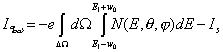
Therefore, the intensity of IL at the analyzer's entrance is: .
The IL intensity is added to the background Is, formed by secondary electrons entering the aperture.
Therefore, the intensity of IL at the analyzer's entrance is:
 |
(6.1.1) |
Here  (see note) - spectrum of the
secondary electrons forming the given IL, w0 - its half-width. This formula is
written while assuming the symmetric IL shape, which is usually not true. In a general case the integration limits
are chosen accordingly to IL shape. (see note) - spectrum of the
secondary electrons forming the given IL, w0 - its half-width. This formula is
written while assuming the symmetric IL shape, which is usually not true. In a general case the integration limits
are chosen accordingly to IL shape.
The double stage model for the IL intensity at the analyzer's entrance gives the
following simple expression in the case of homogeneous semi-infinite sample and the normal incidence of primary electrons
 |
(6.1.2) |
where ip - primary electron beam current,
 - cross section of core level excitation with low angle electron scattering, - cross section of core level excitation with low angle electron scattering,
nj - volume concentration of the j-th element atoms,
 - effective analysis depth, - effective analysis depth,
 - EBE factor. - EBE factor.
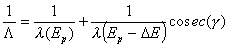
The values of and
depend on primary electron energy Ep:
 |
|
 |
(6.1.3) |
where r - is the EBE coefficient,
( ) - elastic scattering angle, ) - elastic scattering angle,
 - electrons free pass. - electrons free pass.
It is possible to modify (6.1.2) for more complicated cases [Ref 3]:
- non-homogeneous samples;
- two layer samples;
- various film growth modes;
- spectra with other angles of primary electrons incidence and secondary electrons emission, etc.
|




