Handbook of Ionization Spectra
CONTENT
PREFACE
 
1. PHYSICAL ASPECTS OF IONIZATION SPECTROSCOPY TECHNIQUE
1.1. The nature of ionization spectra
1.2. The role of elastic scattering in ionization spectrum formation for reflection geometry
1.3. Inelastic electron scattering
1.4. IL contour
1.5. Fine structure of ionization spectrum
1.6. Ionization losses
1.7. Opportunities of ionization spectroscopy
 
2. IONIZATION SPECTROSCOPY EQUIPMENT
2.1. Electron spectrometer
2.2. Electron gun
 
3. IL DETECTION
3.1. Detection specifics
3.2. Acceleration voltage fluctuations
3.3. Auger lines suppression
 
4. ADJUSTMENT OF SPECTROMETER'S ELECTRON OPTICS
 
5. SPECTROMETER CALIBRATION
5.1. The goal of calibration
5.2. Calibration of kinetic energy scale
5.3. Electron energy loss scale
5.4. Inspection of spectrometer’s adjustment and calibration
 
6. INTENSITY OF IONIZATION LINES
6.1. IL intensity
6.2. Primary electron energy selection
 
7. SURFACE ANALYSIS BY MEANS OF IS
7.1. Qualitative composition analysis technique
7.2. Standard samples technique
7.3. Elemental sensitivity coefficients technique
7.4. Analysis depth
7.5. Investigation of chemical bonding between the atoms
 
References
Ionisation Spectroscopy: Physical Background and Usage (Contents) On-line Library of IS spectra Info System Software and Library   About Authors

7. SURFACE ANALYSIS BY MEANS OF IS

Surface analysis by means of IS consists of determining the elemental and chemical composition of near surface layers. The elemental composition is determined by:

  • method of qualitative composition analysis;
  • method of standard samples;
  • method of elemental sensitivity coefficients.
  • 7.2. Standard samples technique

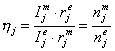
    The standard samples technique is based on comparison of IL intensities from the element of interest in the standard sample and multi-component sample, both of them in-situ. If the standard and investigated samples are close in composition and are measured in identical conditions, the expression for IL intensity contains the same quantities except for concentrations (6.1.2). Then the ratio of IL intensities for measured and standard samples is proportional to the ratio of element's concentrations in measured and standard samples:

    (7.2.1)

    Depending on the IL representation, the intensities and are determined respectively:

  • as areas I(E) under the IL contour N(E) in the integral representation;
  • as peak-to-peak distances (distances between IL extrema) in dN/dE representation.
  • The compositions of measured and standard samples can differ substantially and the intensity ratio / can noticeably differ from unity. In this case one has to consider unequal influences of EBE factors in expressions (6.1.2 - 6.1.3, see also note) on and . While the matrix effects (primarily - EBE factor) are neglected, an error in concentration calculation is greater when the compositions and electron spectra of measured and standard samples differ stronger.


    Look further: 7.3. Elemental sensitivity coefficients technique

    "Handbook of Ionization Spectra"
    ISBN 966-02-1954-7
    © T. Afanasieva, I. Koval,V. Lysenko, P. Mel'nik, N. Nakhodkin, M. Pyatnitsky
    Ukrainian National Academy of Science, Ukrainian Ministry of Education and Science
    Taras Schevchenko University, Radiophysical department
    tel.: +38(044)526-05-60
    e-mail: afanasieva@univ.kiev.ua