Handbook of Ionization Spectra
CONTENT
PREFACE
 
1. PHYSICAL ASPECTS OF IONIZATION SPECTROSCOPY TECHNIQUE
1.1. The nature of ionization spectra
1.2. The role of elastic scattering in ionization spectrum formation for reflection geometry
1.3. Inelastic electron scattering
1.4. IL contour
1.5. Fine structure of ionization spectrum
1.6. Ionization losses
1.7. Opportunities of ionization spectroscopy
 
2. IONIZATION SPECTROSCOPY EQUIPMENT
2.1. Electron spectrometer
2.2. Electron gun
 
3. IL DETECTION
3.1. Detection specifics
3.2. Acceleration voltage fluctuations
3.3. Auger lines suppression
 
4. ADJUSTMENT OF SPECTROMETER'S ELECTRON OPTICS
 
5. SPECTROMETER CALIBRATION
5.1. The goal of calibration
5.2. Calibration of kinetic energy scale
5.3. Electron energy loss scale
5.4. Inspection of spectrometer’s adjustment and calibration
 
6. INTENSITY OF IONIZATION LINES
6.1. IL intensity
6.2. Primary electron energy selection
 
7. SURFACE ANALYSIS BY MEANS OF IS
7.1. Qualitative composition analysis technique
7.2. Standard samples technique
7.3. Elemental sensitivity coefficients technique
7.4. Analysis depth
7.5. Investigation of chemical bonding between the atoms
 
References
Ionisation Spectroscopy: Physical Background and Usage (Contents) On-line Library of IS spectra Info System Software and Library   About Authors

EFFECTIVE ANALYSIS DEPTH

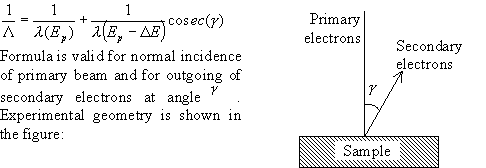
Effective analysis depth effective analysis depth A in IS characterizes the layer of substance where the primary electron excites the core level and experiences elastic reflection at a large angle (necessary to leave the solid in the reflection geometry). The value of effective analysis depth A depends of experiment geometry and mean free path of the electron with initial energy Ep and the energy Ep-deltaE after core level excitation.
The effective analysis depth is determined by the expression:
Expression
"Handbook of Ionization Spectra"
ISBN 966-02-1954-7
© T. Afanasieva, I. Koval,V. Lysenko, P. Mel'nik, N. Nakhodkin, M. Pyatnitsky
Ukrainian National Academy of Science, Ukrainian Ministry of Education and Science
Taras Schevchenko University, Radiophysical department
tel.: +38(044)526-05-60
e-mail: afanasieva@univ.kiev.ua