Ionization spectrum is a part of the secondary electron emission spectrum
N(E), excited by the primary electron beam. Some of the secondary electrons are
loosing a part of their initial energy, higher than certain critical value Ec, for exciting
the electrons from internal atomic levels (core levels) into the empty
states (conduction band) of the solid. The value of ionization loss
 consists of electron binding energy Ec and the
energy consists of electron binding energy Ec and the
energy  of the vacant states in the conduction band:
 | (1.1.1) |
The energies Ec and are given in relation to the Fermi level  , as shown at Fig.1. , as shown at Fig.1.
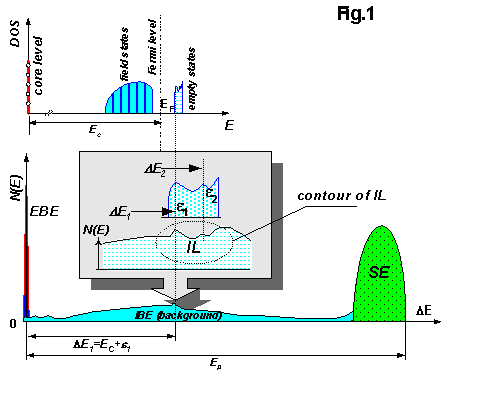
where SE is a true secondary electron peak; IBE (background) – in-elastically scattered electrons
(background); EBE (EBE) – elastically scattered electrons peak; IL – ionization line;
Contour of IL – ionization line contour; DOS – density of electronic states in the solid body; N(E) – energy
distribution of secondary electrons, Core level - internal (core) level.
It should be noted that the ionization line contour reflects the shape of the unoccupied electronic states density.
After ionization energy loss , the electrons which had primary energy Ep are
forming special features (steps and peaks) in the secondary electron spectrum N(E),
corresponding to kinetic energies:
 | (1.1.2) |
These features in the N(E) spectrum (fig.1) are called ionization lines (IL).
The major characteristic of IL is the energy loss . It is referenced to the line of elastically scaterred electrons
(EBE) and does not depend on the primary
electron energy Ep.
The value of is a function of many parameters characterizing the initial
(with energy Ec) and final (with energy ) states of atomic electron in the solid.
The values of Ec and are determined by:
- element’s atomic number Z,
- effective atomic charge (in the compound),
- inter-atomic distances,
- sets of quantum numbers.
As long as Ec>>,
it is enough to identify the initial state (core level) in order
to label the IL, for example: Be K, Si L2,3 etc.
| 



