|
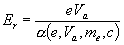
The energy scale E in IS, called kinetic energy scale (see note),
is less convenient than the energy loss scale  based on the
former. Naturally, the errors in measurement contain the
errors in E scale calibration. based on the
former. Naturally, the errors in measurement contain the
errors in E scale calibration.
Kinetic energy scale calibration E (eV) [Ref 9] is done with the
EBE line, which is assumed to have the same position as Ep.
A number of factors limit the precision of this widely used method:
the contact potential difference between the cathode and the internal
electrode of the analyzer;
energetic spread of primary electrons during thermal emission (see note);
energetic spread of primary electrons, due to voltage drop in the directly heated cathode of the electron
gun (see note);
nonlinear dependency E(Va) (see note);
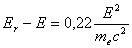
neglecting of relativistic effects (see note);
neglecting the recoil energy in elastic scattering (see note);
the errors in acceleration voltage measuremennts (see note) Vp,
and the voltage Va on the analyzer.
The estimates show that, with these errors, the spectrometers of the same type will produce results within up to
1.35 eV difference. This corresponds to the main error of 0.7 eV.
|