|
Referencing IL position to the kinetic energy scale is inconvenient because its results depend on the selected value
of Ep (1.1.2). It is therefore neccessary to measure the difference Ep - E= instead of E, i.e. the distance between the
EBE and IL lines. The electron energy loss scale serves this purpose.
The loss scale reference point (=0) coincides with the
EBE line (E=Ep), and the directions of E and
scales are opposite. In the process of determination the Ep and E values, it is neccessary to take into
account the difference in line's extremum location for various representations (Fig.). instead of E, i.e. the distance between the
EBE and IL lines. The electron energy loss scale serves this purpose.
The loss scale reference point (=0) coincides with the
EBE line (E=Ep), and the directions of E and
scales are opposite. In the process of determination the Ep and E values, it is neccessary to take into
account the difference in line's extremum location for various representations (Fig.).
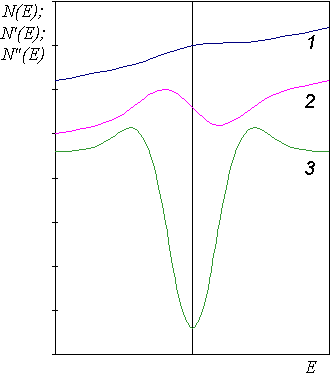
1 - secondary electron energy distribution in the vicinity of IL for integral representations (N(E));
2 - the same in the differential representation (â dN(E)/dE);
3 - the same in the second derivative representation ( ). ).
The relative value of the difference (shift) depends on the modulation magnitude  . If is optimal, and the line is close to the Gauss shape,
than the shift is equal to half the EBE line width. In this case the value of
, measured in the nondifferentiated
(twice differentiated) spectrum and the differentiated one can vary by 0.5..1 eV. This additional error is close to
the main error of energy scale calibration and in some cases (see note)
it is helpful to measure
in the mode, which doesn't give such a difference. . If is optimal, and the line is close to the Gauss shape,
than the shift is equal to half the EBE line width. In this case the value of
, measured in the nondifferentiated
(twice differentiated) spectrum and the differentiated one can vary by 0.5..1 eV. This additional error is close to
the main error of energy scale calibration and in some cases (see note)
it is helpful to measure
in the mode, which doesn't give such a difference.
Taking the zero point of first derivative as the line's position allows to find the true value of
, but this method is less convenient.
| 



