|
The qualitative analysis of pre-surface layer elemental composition is performed by comparing the experimental values
of  for ILs detected in the sample's spectrum with the binding
energies Ec for the elements given in the table of binding energies of atoms. for ILs detected in the sample's spectrum with the binding
energies Ec for the elements given in the table of binding energies of atoms.
The Handbook's software application SpWin allows ILs identification by two complementary techniques.
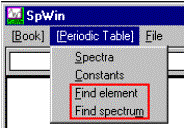
First, setting the line's energy and allowed
deviation of line's energy from the given value, it is possible to obtain a list of atomic energy levels for atoms
with suitable binding energies (menu item [Periodic Table]->Find Element). One must be aware that this technique
uses the table of binding energies in isolated atoms relative to the vacuum level.
This energies can differ from ionization line energies
by several eV.
Second, one can use the search function for the standard ionization spectrum by the energy
of the ionization line, also setting the line energy
and its allowed deviation (menu item [Periodic Table]
->Find Spectrum).
Both techniques require setting the energy and the allowed
line energy deviation from the given value in the opened dialog window (see fig.).
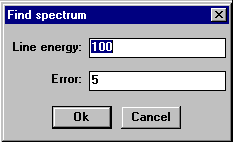
The database search is performed through all lines, whose energy loss is in the interval [LineEnergy - Error .. LineEnergy + Error].
In order to identify elements exactly the standard Handbook spectra are used. While comparing them with the
experimentally obtained spectrum it is necessary to check the correspondence of values and similarity of IL's fine structure and shape.
In the case of ILs overlapping with Auger lines, the later are suppressed by one of the described methods
(paragraph 3.3).
The values of  measured by user and published in the Handbook can differ due to errors in spectrometer calibration
(paragraph 5.2) and different chemical surrounding of the atoms of investigated element.
Before making a conclusion about the influence of chemical surrounding on the value of certain IL (paragraph 7.5), one has to establish the
nature of lines detected in the spectrum. measured by user and published in the Handbook can differ due to errors in spectrometer calibration
(paragraph 5.2) and different chemical surrounding of the atoms of investigated element.
Before making a conclusion about the influence of chemical surrounding on the value of certain IL (paragraph 7.5), one has to establish the
nature of lines detected in the spectrum.
| 



